Nuji, acquired by Klarna
How a social product-discovery marketplace grew to 5m+ items and 37 times its social graph, and why the affiliate model was the right call.
Head of Product · 2011–2015, Director to exit 2020

items from 10,000 designers at the point of acquisition
acquired the team, platform and technology in 2020
Context
Nuji was a social product-discovery marketplace for fashion, lifestyle and home, launched in London in 2011. People curated products from across the web into profiles and followed others whose taste they trusted. The press called it the internet's department store. It reached 5m+ items from 10,000 designers, and Klarna acquired it in May 2020.
I was Head of Product from launch to 2015 and stayed a director through to the acquisition.
Problem
Online fashion retail in 2011 had a search problem dressed up as a discovery problem. If you knew the brand and the product you wanted, every retailer could sell it to you. If you did not, which was most of the time, you were browsing category pages sorted by price.
Underneath that sat the business problem. We had no inventory, no logistics and no buying power. The only asset we could build that nobody else could copy was knowing what a particular person would want next.
My role
Product and design. I owned what got built and why: the discovery and curation model, the catalogue and tagging architecture, the mobile product, and how the whole thing made money. I ran the analytics that told us whether any of it was working.
Insight
We ran monthly analytics from the first month, and one number decided the strategy. Between 2011 and 2012 our content and audience metrics roughly tripled to quadrupled. Connections between people grew 37 times over, from 27,943 to 1,052,000.
Catalogue growth was linear with effort. Social graph growth was not. People who connected to other people came back. People who only browsed products did not. The graph was the asset, not the catalogue.
Product decisions
We optimised for the follow, not the transaction.
Onboarding's job became getting a new person connected to enough others that their feed was worth returning to. That was an uncomfortable call, because it deferred revenue in favour of retention.
We kept the affiliate model and refused checkout.
The alternative was owning the transaction: our own cart, our own payments, our own returns. We would have gained margin and control, and lost the ability to carry 10,000 designers. Outbound clicks to retailers grew 8.2 times that year and attributed order value grew 7.6 times, so the model was working. Owning fulfilment would have buried us operationally.
We measured monetisation as a rate, not a total.
Retailer eCPC, Nuji eCPC, revenue per visitor, and the share of clicks that were monetised, tracked monthly from the start. The monetised-click share told us which parts of the catalogue to expand. Gross revenue would have told us nothing at that size.
Execution
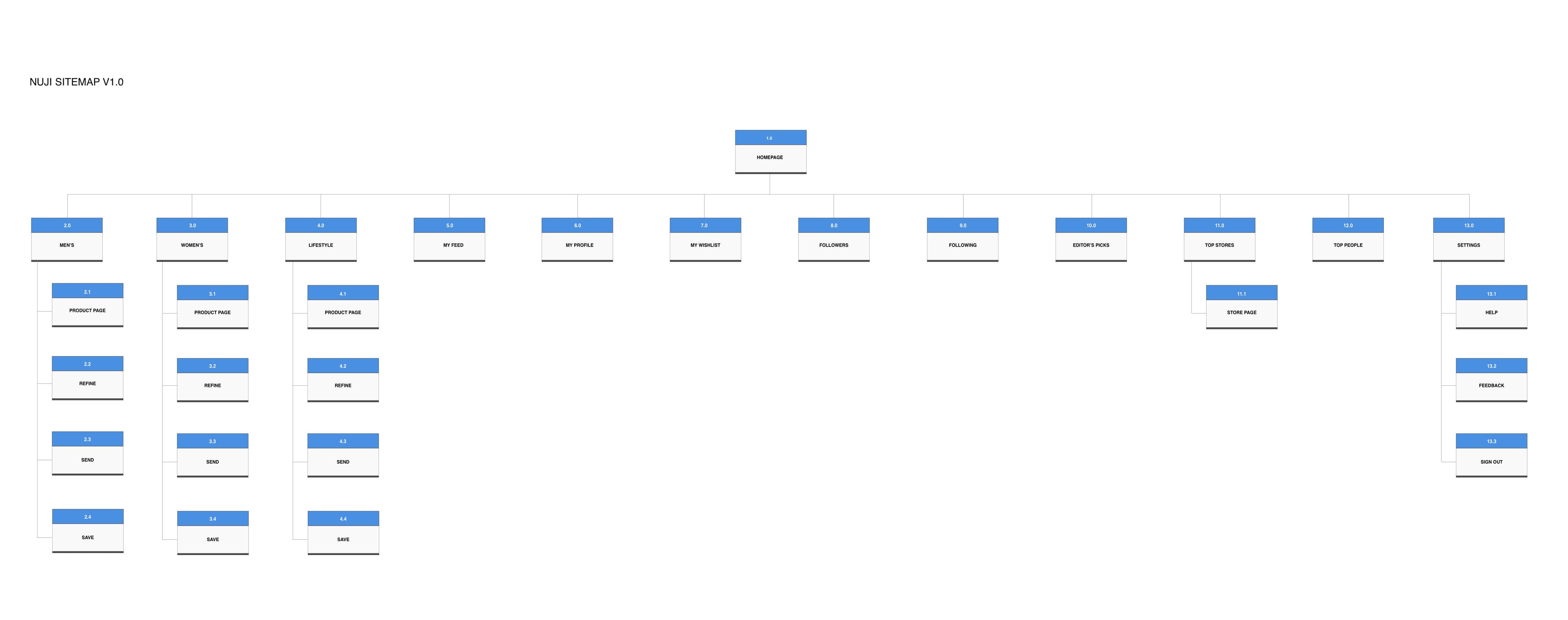
A small team, one weekly analytics review against the same workbook, and a catalogue pipeline that was mostly a crawler plus a tagging system. Most of my week went on the analytics, the Sketch file and the engineers.
Outcome
Between 2011 and 2012, the period where the model proved out:
| 2011 | 2012 | Growth | |
|---|---|---|---|
| Registered users | 7,239 | 36,924 | 5.1× |
| Monthly active users | 1,307 | 9,582 | 7.3× |
| Unique visitors | 165,176 | 720,981 | 4.4× |
| Products in catalogue | 87,935 | 395,400 | 4.5× |
| Retail partners | 10,727 | 27,483 | 2.6× |
| Connections between people | 27,943 | 1,052,000 | 37.6× |
| Outbound clicks to retailers | 12,303 | 100,624 | 8.2× |
| Attributed order value | £60,039 | £455,025 | 7.6× |
The catalogue reached 5m+ items across 10,000 designers. In May 2020, Klarna acquired the team, platform and technology.
What I learned
The metric that matters is rarely the one in the headline. Ours was connections between people, and it sat on row 17 of a spreadsheet for months before anyone worked out what it was telling us.
The other lesson is about ceilings. We built real discovery on someone else's inventory and someone else's checkout, which meant we never owned the moment of purchase. It was the right call for the business we had. It is also why the acquisition was the right ending rather than a disappointing one.